
|
|
United Kingdom
English
United States
English
Botswana
English
Brazil
Português
Canada
English
Canada
Français
Chile
Español
China
繁體中文
Costa Rica
Español
El Salvador
Español
Guatemala
Español
Honduras
Español
Hong Kong
English
Hong Kong
繁體中文
India
English
Kenya
English
Malawi
English
Mexico
Español
Namibia
English
Nicaragua
Español
Philippines
English
Rwanda
English
South Africa
English
Tanzania
English
Trinidad and Tobago
English
Uganda
English
Zambia
English
Zimbabwe
English
What the Latest Global Fraud Trends Report Reveals for the UK

Digital fraud continues to reshape how consumers engage online. The latest findings from our Global Fraud Trends Report show while the UK has made meaningful progress in reducing fraud rates, the threat is becoming increasingly targeted, sophisticated and personal.
At the heart of this shift is identity. Fraud is no longer just about stolen card details or isolated attacks. It has evolved into impersonation, deception and persuading consumers to authorise fraudulent activity themselves. For UK businesses and consumers alike, this has important implications for trust, security and the future of digital experiences.
Fraud losses remain a real cost for UK consumers
Despite declining fraud attempt rates overall, the financial impact on those who are affected remains significant. The median UK consumer‑reported loss among those who lost money to digital fraud in the past year was £1,205.1
“Headline fraud rates can be misleading. Even when fewer people are affected, the damage is often deeper. For those who do fall victim, losses are substantial and the emotional impact can linger long after the money is gone.”
Sarah Golding, Head of Solutions Consulting – Fraud & Identity, TransUnion.
This highlights an important reality: A reduction in fraud volumes does not automatically translate to reduced consumer harm. When fraud does succeed, it often results in substantial losses for individuals and long‑lasting damage to confidence in digital channels.
Phishing dominates the UK fraud landscape
Among UK respondents who reported losing money to digital fraud, phishing was the most common scheme, accounting for 26% of reported losses.1 This was followed closely by stolen credit cards or fraudulent charges, responsible for 23% of losses.1
Today’s phishing attacks are rarely basic or easy to spot. Fraudsters are increasingly combining convincing emails, text messages and voice calls with stolen data, social engineering and time pressure. These tactics are designed to manipulate trust and bypass traditional security controls that focus on credentials alone.
Trust is now the defining factor in digital choice
As fraud tactics evolve, consumer expectations are rising just as quickly. In the UK, 76%1 of consumers said confidence their personal data will not be compromised is very important when choosing who to transact with online, making data security the strongest driver of digital trust.
“UK consumers are making trust-based decisions with their wallets. If people don’t feel their identities and data are protected, they won’t complete the transaction — and may not come back. Security has become a visible part of the brand experience.”
Sally Henstock, Product Lead for Digital Identity, TransUnion.
This has become a decisive brand differentiator. Consumers are willing to abandon transactions, switch providers or disengage entirely if they suspect their data or identities may be at risk. Organisations that fail to demonstrate visible, meaningful protection risk falling behind.
Falling fraud rates mask a changing threat
The UK continues to report one of the lowest suspected digital fraud rates globally — sitting at 2% in 2025.1 While this reflects strong controls and early adoption of technologies, such as strong customer authentication, it also hides a critical shift in attacker behaviour.
“Lower fraud rates don’t mean lower risk. What we’re seeing in the UK is a transition from blunt, high-volume attacks to quieter, more convincing identity-based scams. These tactics exploit trust and legitimate access, which makes them far harder to detect with traditional, rules‑driven defences.”
George Rhodes, Senior Identity & Fraud Specialist, TransUnion.
Fraudsters are increasingly exploiting legitimate access, persuading consumers to approve payments or disclose sensitive information themselves. These attacks often look entirely genuine and are harder to detect in real time using rules‑based or fragmented defences.
Account creation is emerging as a key risk point
Across the UK, account creation is now the riskiest stage of the digital customer lifecycle, with suspected fraud rates increasing noticeably in 2025.1 Fraudsters are targeting onboarding journeys using synthetic identities, manipulated documents and automated bot activity, aiming to embed themselves before stronger controls are applied.
This reinforces the need for identity‑centric fraud prevention from the very start of the customer journey. Device intelligence, behavioural signals and adaptive verification play critical roles in identifying risk early while maintaining smooth experiences for genuine users.
Looking ahead: Protecting trust in a digital‑first UK
The UK’s fraud landscape shows both progress and pressure. Technology and regulation have helped reduce overall fraud volumes, but criminals are adapting quickly, shifting toward harder‑to‑detect, identity‑led attacks that challenge traditional defences.
For organisations, the challenge is no longer simply how to block fraud. It’s how to verify a digital customer is genuine, consistent and trustworthy across channels over time —without adding unnecessary friction.
To dig deeper into the insights behind these findings — and see how fraud is evolving across markets — explore the latest Global Fraud Trends Report.
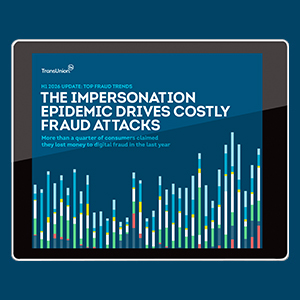
The Impersonation Epidemic Drives Costly Fraud Attacks
H1 2026 Update: Top Fraud Trends




Contact Us
We're sorry, your request failed. Please try again in a little while.

Information for Good®.
Connect with us
